Every year, lakhs of aspirants across India sit down with stacks of books, a rigid timetable, and one singular goal — clearing the UPSC Civil Services Examination. For many, it is the most ambitious pursuit of their academic lives. But if you are just starting out, the first question is simple: what exactly is this exam, and why does it matter so much?
Table of Contents
What is the UPSC Civil Services Exam
The UPSC Civil Services Examination is a national-level competitive exam conducted by the Union Public Service Commission (UPSC) to recruit candidates for India’s top administrative, police, and foreign services. It selects officers for prestigious posts like the Indian Administrative Service (IAS), Indian Police Service (IPS), and Indian Foreign Service (IFS) — along with over 20 other Group A and Group B central services.
In short — it is the gateway to running the country. Candidates who clear this exam step into roles that directly shape governance, law enforcement, diplomacy, and public welfare at every level.
Who Conducts the UPSC Exam in India
UPSC, the Union Public Service Commission, is a constitutional body established under Article 315 of the Indian Constitution. Its mandate is straightforward: merit-based, transparent recruitment for central government services. No political interference. No shortcuts.
Here is the eligibility criteria at a glance:
| Criteria | Requirement |
| Nationality | Indian citizen (for IAS/IPS/IFS) |
| Educational Qualification | Graduate degree in any discipline from a recognised university |
| Age Limit | 21–32 years (General category) |
| Age Relaxation | OBC: +3 years | SC/ST: +5 years | PwBD: +10 years |
| Number of Attempts | General: 6 | OBC: 9 | SC/ST: Unlimited (till age limit) |
Note: Age limits and attempt counts are governed by the official UPSC notification issued each year. Always verify current rules on the official UPSC website (upsc.gov.in) before applying.
UPSC Civil Services Exam Stages
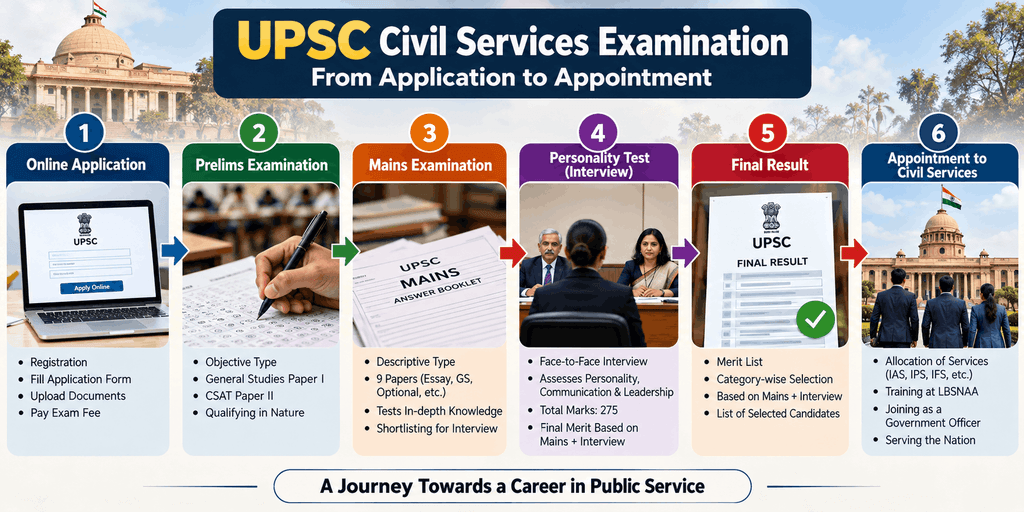
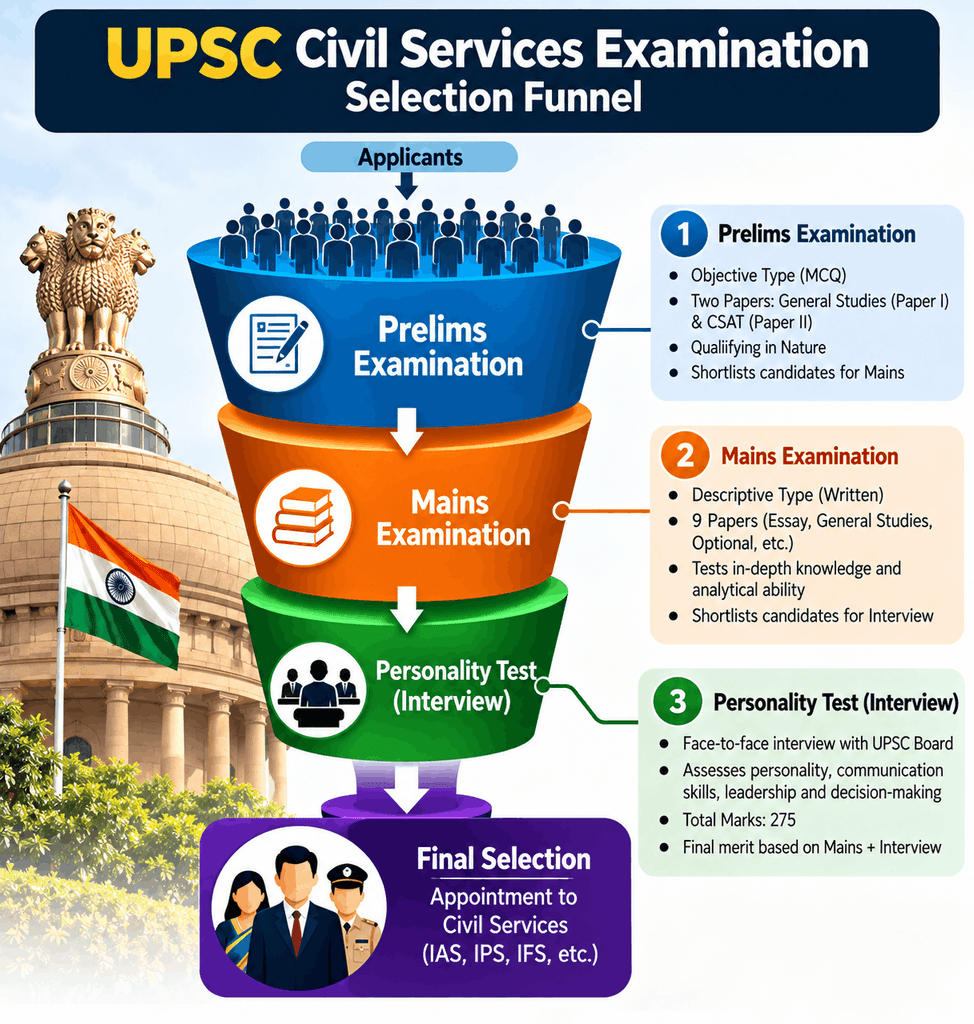
This is where it gets serious. The UPSC Civil Services Examination is not a single test — it is a three-stage selection process spread across nearly a year. Pass all three, and you earn a place on the final merit list.
Stage 1 — Preliminary Examination (Prelims)
Prelims is a screening test, not a merit test. It consists of two objective-type papers, each carrying 200 marks:
- General Studies Paper I (200 marks) — covers history, geography, polity, economy, environment, science & technology, and current affairs.
- General Studies Paper II / CSAT (200 marks) — tests reading comprehension, basic numeracy, and analytical reasoning. This paper is qualifying only; a minimum of 33% is required.
Only Paper I marks count for shortlisting to Mains. Roughly 10–15 times the total vacancies are selected at this stage. Hundreds of thousands attempt it. Most stop here.
Stage 2 — Main Examination (Mains)
Mains is where depth matters — and where the real filtering happens. It is a written examination with 9 papers in total:
| Paper | Subject | Marks |
| Paper A | Indian Language (Qualifying) | 300 |
| Paper B | English (Qualifying) | 300 |
| Paper I | Essay | 250 |
| Paper II–V | General Studies (4 papers) | 250 each |
| Paper VI–VII | Optional Subject (2 papers) | 250 each |
| Total Merit Marks | 1,750 | |
| Qualifying Papers | Not counted in merit |
Mains tests analytical thinking, essay writing, and subject-matter depth. It is not about how much you memorised — it is about how well you can structure and communicate ideas under pressure.
Stage 3 — Personality Test (Interview)
The final hurdle. Candidates who qualify Mains appear before a UPSC board for a structured interview worth 275 marks. It is often misunderstood as a stress test. It is not. The board evaluates your personality, reasoning ability, ethical outlook, and overall suitability for public service.
The final merit list is prepared on the basis of Mains + Interview combined — a total of 2,025 marks. Your Prelims score plays no role in the final ranking.
Services Allocation After Clearing the UPSC Exam
Clearing the UPSC Civil Services Examination opens the door to over 24 services. The allocation depends on your all-India rank and your service preferences submitted during the form-filling stage. The top rankers typically secure IAS or IFS. Here are some of the most sought-after:
- IAS (Indian Administrative Service) — district and state-level administration, policy implementation
- IPS (Indian Police Service) — law enforcement, intelligence agencies, paramilitary leadership
- IFS (Indian Foreign Service) — diplomacy, embassies, multilateral organisations abroad
- IRS-IT (Indian Revenue Service – Income Tax) — tax administration and investigation
- IRS-C&IT (Indian Revenue Service – Customs & Indirect Taxes) — customs, GST enforcement
- IRTS, IDAS, ITS — Indian Railway Traffic Service, Defence Accounts Service, Telecom Service
Each service comes with its own posting zones, cadre allotment, and career trajectory. But all of them offer job security, a government salary with DA, and the weight of institutional authority that no private sector role quite matches.
UPSC Exam Difficulty Level
Honest answer — yes. But the difficulty is specific, not absolute.
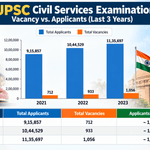
The selection rate is typically around 0.1% to 0.3% of all applicants. In 2023, UPSC recommended 1,016 candidates out of approximately 9.8 lakh who appeared for Prelims. That is a brutal filter.
But here is what those numbers do not show: a significant number of successful candidates clear it on their first or second attempt with a clear preparation strategy. The exam rewards consistent, structured study over marathon cramming sessions. It rewards the ability to think and write — not just memorise dates.
The difficulty is real. But it is not unreachable — and for lakhs of students, teachers, and job seekers across India, it remains the most credible path to a career in public service.